
Nvidia Is Becoming the AI Nation-State
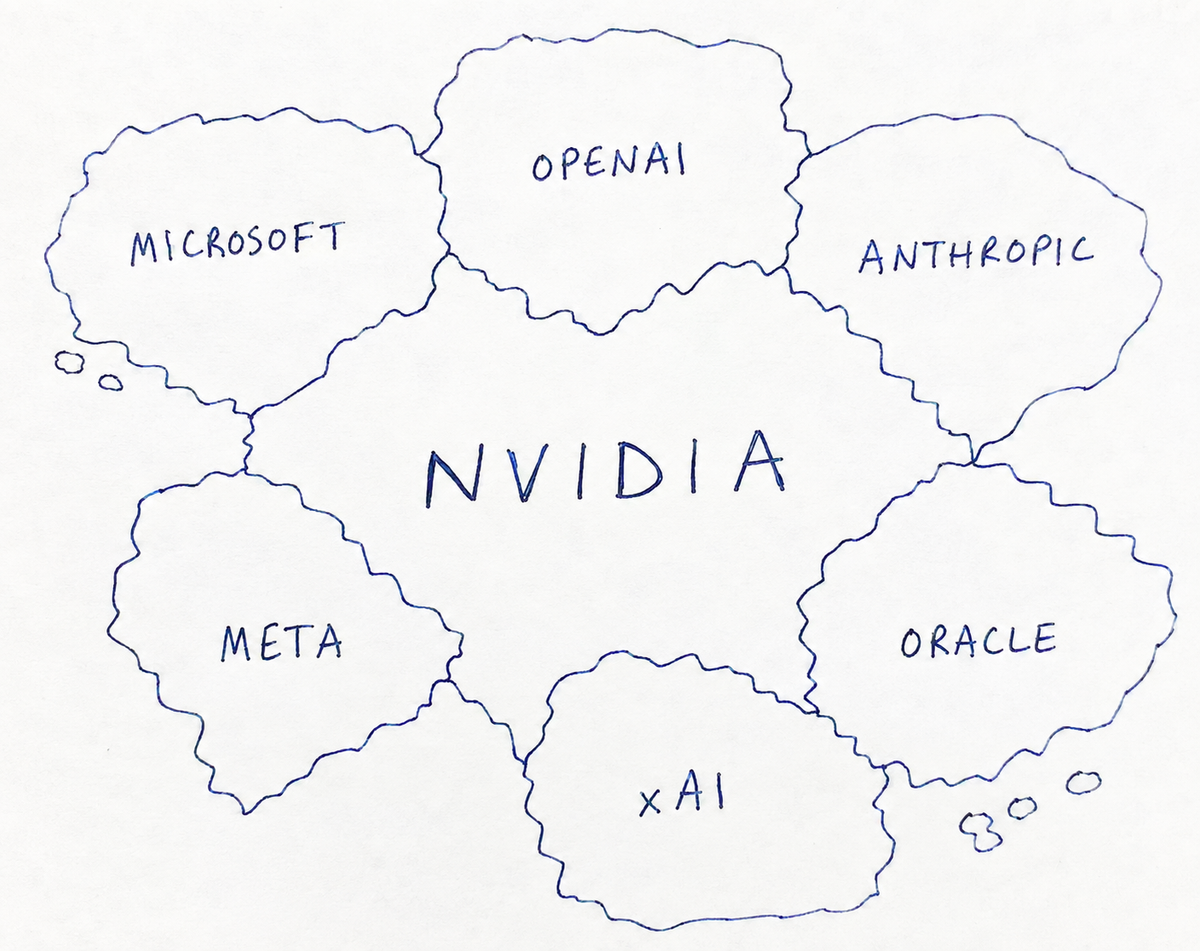
There is plenty of talk about circular financing in AI, especially around Nvidia. The concern is legitimate. But the phrase carries historical baggage. In its worst forms, circular financing manufactured the appearance of demand: a vendor financed its own customers and then presented those purchases as evidence of genuine, independent market demand. That can become a house of cards very quickly.
Recent reports that Nvidia has supported financing for major AI infrastructure projects have reignited those concerns. But Nvidia may be doing something fundamentally different. It is increasingly behaving less like a semiconductor company and more like a nation state investing in a strategically important industry.
Nation states subsidize industries because creating scale can ultimately benefit the entire country. China's support for its EV industry helped domestic manufacturers reach the scale needed to compete globally, generating benefits through exports, employment, technological leadership and supply-chain control. Nvidia may be making a similar calculation. If helping customers build AI infrastructure today produces a much larger AI economy tomorrow, the payoff is not merely today's "circular" GPU sale. It is the next decade of demand for Nvidia's computing platform.
The obvious question is why conventional finance is not providing all the necessary capital. Nvidia has several advantages over ordinary lenders. AI projects are extraordinarily large and create concentration, duration and technology risks that conventional lenders may struggle to understand, let alone absorb. Nvidia has both substantial financial capacity and a strategic reason to accept those risks. Traditional lenders seek repayment. Nvidia seeks ecosystem expansion. Those are fundamentally different objectives. It also sees demand across the AI ecosystem rather than through the financial statements of a single borrower, and likely understands deployment progress, technical risk and the residual value of its own hardware far better than a bank. These asymmetric informational advantages may allow it to assess risk more accurately.
But perhaps the most important difference is that Nvidia captures ecosystem externalities that private capital largely cannot. Every successful AI deployment expands the CUDA developer base, creates new applications, attracts more developers and ultimately increases demand for future AI infrastructure. A bank finances a single project and earns interest. Nvidia helps finance an ecosystem and earns a larger future market.
This is where the nation-state analogy becomes most compelling. Governments often subsidize strategically important industries because the long-term benefits spill far beyond the companies receiving the investment. Private investors cannot capture those broader returns, so markets may rationally underinvest. Nvidia may occupy a similarly unusual position. It captures enough of those ecosystem-wide benefits that investing in AI infrastructure could be economically rational even when conventional financiers would hesitate.
The strongest counterargument returns to the opening question of genuine market demand. Nvidia may understand medium-term demand for GPUs better than anyone else, but that does not necessarily mean it can predict whether businesses and consumers will ultimately derive enough value from AI to justify today's extraordinary investment. If AI applications fail to generate the expected economic value, the flywheel breaks. Nvidia may then simply have accelerated future purchases into the present rather than helping create a self-sustaining market. The nation-state strategy works only if the industry being subsidized can eventually thrive on its own.
I think it will. Where others see problematic circular financing, I see smart investment in the next industrial revolution. That's the bet I'm making.
Disclosure: I am long Nvidia.
Enjoyed this?
Subscribe to Tanner on Tech for new articles.
Related

AI
When Privacy Becomes a Product Constraint
As we say farewell to Tim Cook, one of the most successful CEOs in tech history, it only seems appropriate for a blog that vaguely promised irreverence to offer a critique rather than praise. You can find the praise elsewhere, and it is of course very well deserved. My issue
AI
Flight to Apple
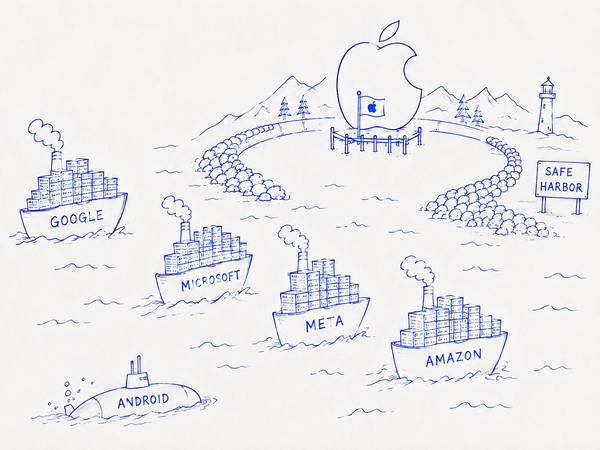
Recently, Apple stock has been behaving like a flight to tech safety investment. The more people panic about hyperscaler capex, the more attractive Apple stock seems to become to them. But do we think this is rational? Well, I will have more to say about the hyperscaler capex panic (spoiler:

AI
Hugging Humanity
The Hugging Face hack changed my mind about the risks of AI. It's time I accepted they are non-trivial. My thought process is something like this: We are probably on the brink of recursive self improvement of models at least to some degree. As such, intelligence will
Member discussion
0 commentsStart the conversation
Become a member of Tanner on Tech to start commenting.
Subscribe for free