
Netflix Renewed Me. Until I Worried It Wouldn't Renew My Shows.
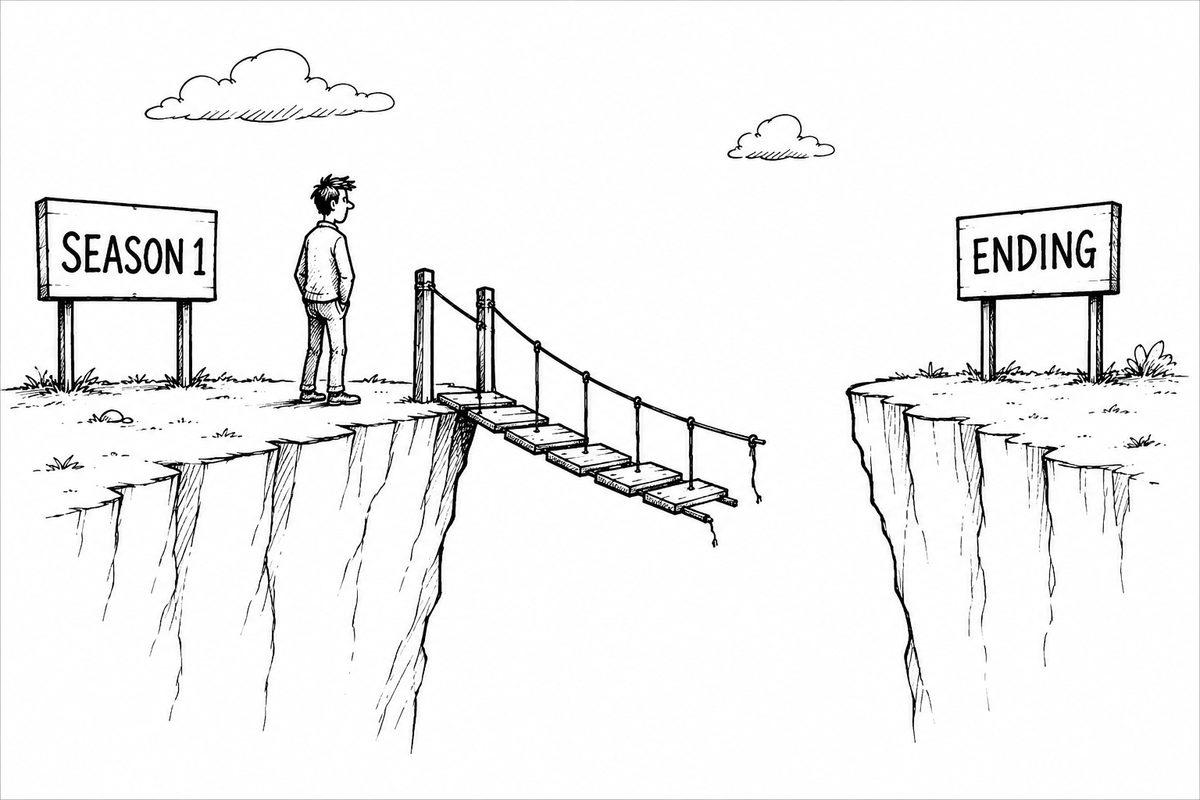
I cancelled Netflix three months ago, and I've spent much of the time since asking myself why.
On paper it makes little sense. Netflix isn't overtly expensive. The recommendation engine is the best in the business. There was a mountain of stuff I hadn't seen. But I just gradually stopped starting things — seeing something promising, feeling a flicker of interest, and scrolling past like a 20-year-old speed swiping in a dating app. Not rejecting the recommendation, so much as declining to invest my attention.
Here's the part that should worry Netflix more than my cancellation. If they had asked why in a survey or focus group I would probably have told them there wasn't anything I wanted to watch. And I'd have meant it. Most people don't introspect for three months like I have. Now my answer is different.
The answer problem
Netflix knows more about viewing behaviour than I ever will. I'm sure it surveys lapsed subscribers, runs focus groups, and analyses churn in extraordinary detail. But even if it asks exactly the right question, it may not get the right answer.
In my old world — I taught marketing — behavioural research consistently finds that people are poor at explaining the real causes of their own decisions. Sometimes that's social desirability bias: we give the answer that sounds reasonable, or flattering to us. Sometimes it's the introspection illusion: we just genuinely don't have access to why our behaviour changed, so we construct a plausible story afterwards and believe it completely. Either way, I doubt many people say "I've become emotionally risk-averse about television." I think that was my real reason. I didn't trust the shows I started to end.
"There wasn't anything I wanted to watch" would have been an honest answer from me when I cancelled. It just was not the deeper reason. And the two answers point at completely different solutions: one to a discovery problem, fixable with better recommendations, and one to a trust problem, which better recommendations cannot touch. So getting the right answer really matters. And it matters well beyond my subscription — because the trust problem and Netflix's most conspicuous strategic weakness turn out to be potentially related.
The $83 billion tell
In December 2025, Netflix agreed to pay roughly $83 billion for Warner Bros.' studio and streaming business. It ultimately lost out to Paramount, but set aside who won. The interesting thing is that Netflix was in the room at all.
It has the best audience data in entertainment, the best recommendation engine, more original production than any other studio, and global distribution its rivals would kill for. And yet it went shopping for Harry Potter and DC. Netflix plainly knows it needs more franchises — you don't bid $83 billion for something you think you can make yourself. What it might not fully understand is why it has made so few itself.
Here's the thing, though. Almost nobody invents a franchise from scratch anymore. Harry Potter came from novels, DC from mid-century comics, Star Wars from my distant childhood. The studios that "own franchises" mostly bought or adapted them, which is why buying the vault at auction is the reflexive strategic response. Netflix can't conjure a Wizarding World out of the ether. Neither can anyone else. (Well, I do have a secret Creato Franchiso spell, but it's hard to cast.)
But franchises do get grown. Game of Thrones was a mid-budget fantasy gamble in 2011. Bridgerton was a costume drama nobody expected to matter. Those weren't acquired fully formed, they were cultivated — and cultivation into franchise is the achievable target. Notice what it requires. A franchise is a show people came back to, season after season. Every season is another moment where a viewer decides whether to invest again. That makes willingness to start a key raw material for a franchise, not a side effect of one. Which is why a trust problem and a franchise problem are the same beast viewed from two ends. I suspect Netflix's model is accidentally designed to erode trust and they're then puzzled by the lack of franchises that emerge.
HBO proves it's achievable
HBO has almost no fully exploitable IP. Game of Thrones is the exception, and tellingly it came from a novel. I'd happily buy a fast pass at a Game of Thrones world, but my wife would likely excommunicate me.
Nobody would say HBO can't grow a TV franchise, though. Succession, The Sopranos, The Last of Us: shows people wait for. Two things distinguish it, and neither is money.
It has never binged. Yes they grew up in the linear TV world, but HBO has stuck with the weekly model continuously through the entire streaming era, which is the cleanest available evidence that release cadence has benefits. Weekly doesn't just stretch content across two months, it stretches conversation — every episode is another occasion for a friend to recommend a show or a colleague to bring it up. Netflix compresses that whole social process into a weekend, and the talk burns hot and vanishes. The watercooler effect isn't just free marketing; it's one of the mechanisms by which a show becomes a franchise.
And HBO's scripted dramas almost always finish. Viewers trust shows will conclude, which is precisely why it's emotionally safe to begin them. Note that HBO's gaps between seasons are often terrible — two years is normal, and Euphoria took four. It works anyway. That suggests a key variable is likely expectation of an ending, not cadence. HBO's gaps are long but certain; Netflix's are long and uncertain. The waiting isn't the problem. The uncertainty is.
Apple runs the same play via an open chequebook
Apple pre-renews. Slow Horses was renewed for seasons three and four before season two had aired, and through season seven in July 2025. A new season every year, on a schedule its director describes as unhurried. Commit before the data exists and the production machine never goes cold — which is also, incidentally, why Netflix's renewal gaps run so long, since deciding after a month of viewing numbers means rebuilding a dissolved production from scratch.
It helps that Slow Horses has the Slough House novels behind it — Apple roughly knows what seasons five, six and seven are before season one airs, which turns an open-ended creative bet into a known-duration one and makes committing early easier. But that isn't some special Apple insight. Netflix adapts constantly, and at far greater volume: Bridgerton, The Witcher, One Piece, The Sandman. It holds the same asset. The difference is the degree of up-front commitment.
And Netflix understands public commitment can be a positive, because it has already done it once. In April 2021, after a single season, it renewed Bridgerton for seasons three and four simultaneously, and said out loud that the point was to plan and prep upcoming seasons in advance to sustain a pace. Bridgerton is now renewed through season six of a planned eight — one per Julia Quinn novel — with a spinoff attached. In February this year, while The Night Agent's third season was managing 9.9 million views in its second weekend, Bridgerton was doing 28 million in its fifth week on the Top 10. It is the closest thing Netflix has grown to a genuine franchise, and it was built by committing early to a story that already had a shape.
The obvious retort is that Netflix only pre-renewed because season one was a cultural phenomenon — and that it would happily do the same again for the next one. That's fair. But it's also the problem. Netflix isn't entirely unwilling to commit early; it's just that the bar for commitment is set at "generational hit." Almost nothing clears it, and by the time something does, the data has already told you the answer. A commitment made after the evidence isn't a strategy, it's a reward.
The other objection is that Apple can afford patience because Apple TV isn't really a business yet; it reportedly loses money at a scale no standalone streamer could survive. Fair. But that doesn't touch the behavioural point. Whatever the source of the commitment, the viewer experiences the same thing — shows that arrive when expected and are allowed to finish. I will happily start an unfamiliar Apple show on the strength of the logo and the knowledge that if the emotional journey grabs me, I have a great chance of experiencing the whole journey. I would not watch Foundation on Netflix. I would be terrified of Netflix pulling it. I'm worried even at Apple. (Please don't pull it, Eddie.)
The loop closes
You get burned a few times and you quietly stop taking chances. Maybe you throw an extra Apple TV show in the rotation instead of a Netflix one. Early audiences come in a tad thinner. The Netflix analytical machine observes weaker engagement and becomes less willing to renew marginal series. Viewers observe slightly more cancellations and grow more cautious still.
Nothing irrational happens at any step. The data is entirely accurate. Every decision is defensible on its own terms. But the company's reputation has become one of the variables generating the behaviour it is measuring. The demand curve isn't sitting out in the world waiting to be excavated. Netflix is helping construct it.
Consistent with this, look at the survivors rather than the cancellations. An analysis of every US scripted series Netflix has released since 2016 found that the real risk isn't surviving season one — it's reaching season three. A platform with a discovery problem would struggle to launch shows. Netflix launches like a well oiled machine. What it can't reliably do is compound.
What I can't prove
Netflix doesn't seem to cancel at a higher rate than its peers. One study of the major streamers put the overall rate around 12%, with Max (as distinct from HBO) the worst offender by some distance, and Netflix's own renewal rate has held stable for years even as the absolute number of axed shows climbed.
But rate isn't the only thing viewers meet. Nobody watches enough television to be personally burned more than a few times. What they encounter is the discourse — the cancelled-on-a-cliffhanger headline, the Facebook thread, the friend bitching. And that scales with output, not with rate. Make eight times as many shows as Apple and you generate eight times the cancellation stories even if killing the same proportion. Renewals, meanwhile, make no news at all. So Netflix's scale is what makes it look untrustworthy. It doesn't need to cancel at a higher rate than anyone else; it only needs to be believed to.
Existing surveys don't flag this. Ask people why they cancelled a streaming service and price dominates, at around 40%, with missing titles a distant second. Nothing about trust registers at all. Of course, my argument predicts exactly that result: people give the quick socially justifiable answer, not the three-month introspection one.
But this is nonetheless a measurable insight, just not optimally by questionnaire. You would need in-depth interviews built around behaviour rather than reasons — walk me through the last time you opened Netflix, what you nearly watched and didn't, what were you thinking as you scrolled past — and peel back the onion from there. That is standard technique and it surfaces things respondents would never volunteer in a survey textbox. Netflix may well be doing exactly this, and I have no way of knowing. My suspicion is that it isn't, or isn't doing much of it, because depth interviews don't scale and Netflix has spent fifteen years optimising toward instruments that do. Twenty good interviews with my fellow cancellers could likely find this. Twenty interviews don't produce a metric.
They also likely have the key behavioural data, something like the share of subscribers who sample an unfamiliar scripted original in its first month, tracked as a time series. If that's flat, I'm not wrong about myself, but I am wrong to generalize beyond me. But if it is falling... Netflix, send me the data. Let's chat, I love data. Though I notice you've stopped sharing it.
A partial solution? Longer-dated show options
Forgive me — I did my MBA at Chicago and I'm a finance geek still, so the option metaphor that follows was probably inevitable.
I don't think any of this requires Netflix to stop being Netflix. Its model is basically to buy cheap one-period show options: fund a season, read the data, close out of the money positions. The flaw isn't the options per se, it's that Netflix invests in only one duration—one season.
So buy some longer-dated ones. Lower the strike price on them. That's what the Bridgerton story is really about: not that Netflix refuses to commit early, but that it only does so for generational hits. Set the bar lower and pre-renew a dozen plausible candidates a year — two seasons deep, screened weekly, maybe shorter seasons, biased toward optioned book series it already has in the pipeline. This would be a minor shift, not a cultural conversion. Netflix's stated objection to weekly release is volume: you cannot run marketing campaigns for twenty simultaneous shows, and at five to ten new originals a week the schedule collapses. Which is exactly why you don't convert the slate. Run ninety percent of it as it is. Twelve titles is a marketing calendar you can actually run.
Then announce them. Netflix already publicises renewals; it just does so after a season, when the news value is spent and the viewer has already decided. Announcing two seasons at greenlight costs nothing. Every other fix on this list happens inside Netflix; this is the one that reaches the person deciding whether to press play. Bridgerton's double renewal was announced publicly, with the reasoning attached, so Netflix can do this.
And there's a potential spot for those dozen titles that Netflix has been sitting on since January 2025 without apparently noticing what it is. WWE Raw has streamed live every Monday at 8pm ET for nineteen months and become a fixture in the weekly Top 10. That's an appointment habit, already installed. And it addresses the volume objection, because you don't market twelve shows — you market a night. HBO never ran twelve campaigns; it ran one, for Sunday, for decades, and the night became the brand that made people sample whatever was in it. Netflix is building the habit but only booked wrestling.
Against a content budget north of $17 billion, the whole thing is an option premium of maybe two percent? That buys you greater exposure to franchise upside. The risk-reward seems like a step forward.
And Netflix's current threshold isn't miscalibrated by accident. It's tuned to avoid the one error it can see: funding a second season nobody watches. It's blind to the opposite error — though not incurably. Pre-renew a random subset of borderline shows and you'd have your answer. But nobody runs that controlled experiment, because it costs real money now to learn something in 2029. And absent that experiment, a series that might have become a franchise if given three seasons, but never got them, leaves no trace. You cannot measure the impact of the show you didn't make. Not without a Tardis, hell maybe Netflix should help the BBC reboot Doctor Who. Two birds baby!
Which is why the strike stays high, and why the two percent never gets spent. Netflix doesn't need to stop measuring. It just needs to buy a few longer-dated show options and let viewers see them. But the payoff wouldn't show up in the dashboard for a decade, and Netflix only renews what the dashboard can already see. Which is how a company that renewed my subscription for a decade ended up losing it.
Disclosure: I am long Netflix. I know. The lesson is the next time I cancel a service, I’ll check if I own the stock.
Enjoyed this?
Subscribe to Tanner on Tech for new articles.
Read next
AI
Nvidia Is Becoming the AI Nation-State
There is plenty of talk about circular financing in AI, especially around Nvidia. The concern is legitimate. But the phrase carries historical baggage. In its worst forms, circular financing manufactured the appearance of demand: a vendor financed its own customers and then presented those purchases as evidence of genuine, independent
Meta
THE BUT-IT'S-FUCKING-AMAZING FALLACY
I have been thinking more on this quote from the Meta and AGI article earlier in the feed: “But willingness to make enormous bets, and judgment about which enormous bets to make, are very different CEO capabilities.” I think there is much to learn from Segway. Back in the early
AI
When Privacy Becomes a Product Constraint
As we say farewell to Tim Cook, one of the most successful CEOs in tech history, it only seems appropriate for a blog that vaguely promised irreverence to offer a critique rather than praise. You can find the praise elsewhere, and it is of course very well deserved. My issue
Member discussion
0 commentsStart the conversation
Become a member of Tanner on Tech to start commenting.
Subscribe for free