
Meta Needs AI but maybe not AGI
Meta Needs AI but maybe not AGI
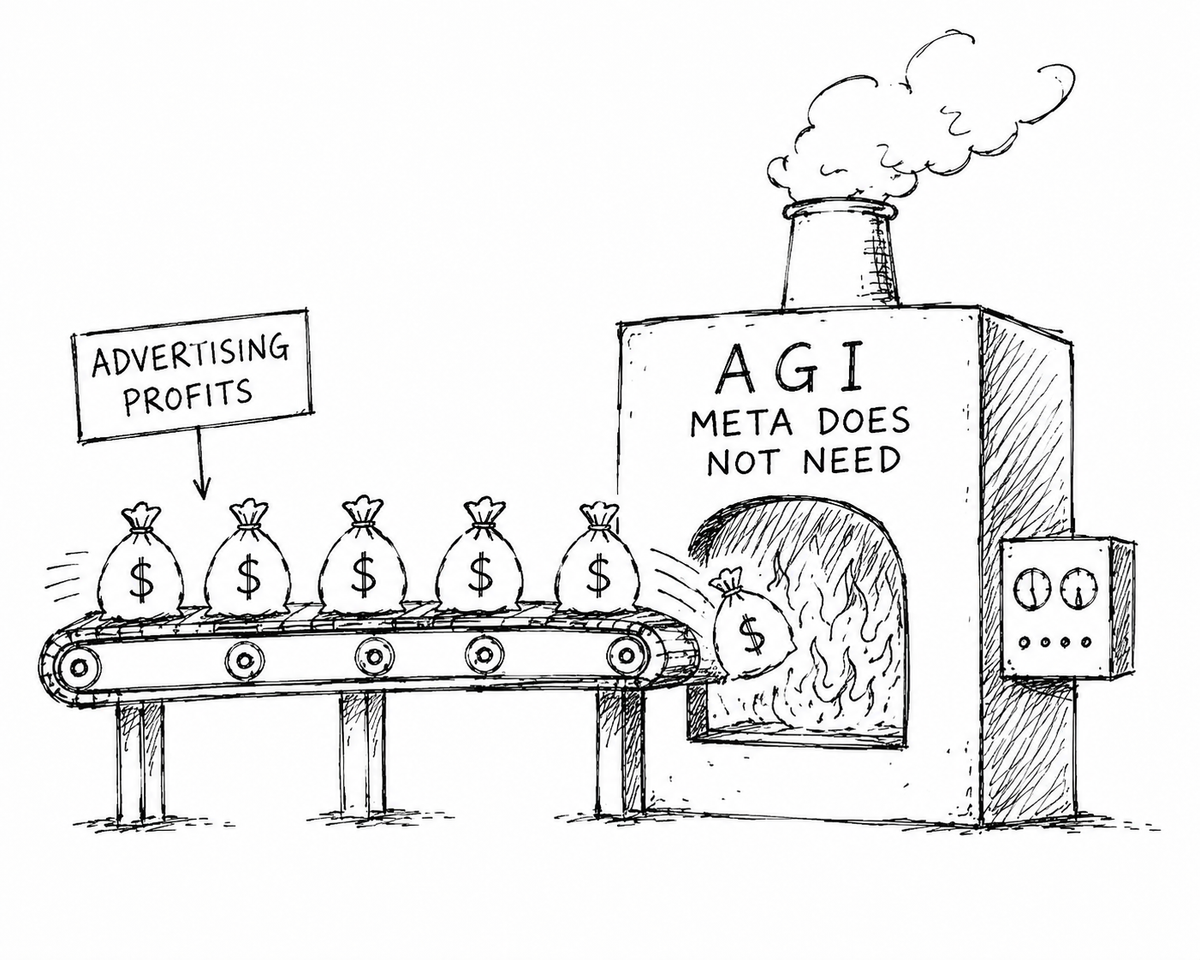
Why is Meta trying to compete at the AI frontier and pursue “personal superintelligence”? It is a question I return to every earnings call, because Zuckerberg has yet to offer an economically compelling answer.
Meta unquestionably needs AI. Machine learning drives ad targeting, recommendations and engagement, and the results have been fabulous: users spend more time on Reels, advertisers receive better conversions, and Meta’s core grab-eyeballs-and-sell-ads flywheel is kicking a lot of ass. Indeed, European regulators now object that their platforms are becoming too addictive—a ringing implicit endorsement if ever I saw one. So far so great.
Building much of that technology internally absolutely makes strategic sense. Meta does not want its core products dependent on frontier labs—or, worst case, Google, its largest advertising rival—charging it high rents for essential models.
But none of that explains why Meta needs to own the frontier.
Facebook, Instagram and WhatsApp are innately social products: their principal value comes from interactions amongst us humans. AI can improve discovery, creation, advertising and moderation, but it is not obvious that these tasks require Meta to build the world’s best general-purpose model and deliver superintelligent agents. Super intelligent agents sound like a post-hoc justification, not a true strategic need. I am, for example, in a fair few middle aged men WhatsApp groups, and in none of them are we currently trying to solve cold fusion, although breakthrough prostate science would make some of us happy.
Meta has no expertise in serving the enterprise customer. No substantive relationships, sales force, systems, nothing. And yet they have now launched Muse Code, a Codex/Claude Code competitor. Now, to be fair, maybe Meta has the internal scale to justify building a coding tool for its own developers, and then to keep it competitive you need more data, so then you sell it externally. Possible. I’m dubious though, it feels more like that since they are chasing the frontier anyway, they figured let’s follow the frontier model companies into coding.
The strongest justification for this frontier pursuit is optionality against future platform risk. Meta was partially disintermediated on mobile by Apple and Google. If personal AI assistants become the next operating layer—and AI glasses become an important interface (not my bet, I think the phone persists, but still)—Meta does not want to depend on somebody else’s intelligence. Meta’s official strategy increasingly points in this direction: distributing a personal assistant across its apps and glasses, rather than merely improving the existing feed.
That is fair to some degree, but it still does not establish that winning the frontier race is necessary, rather than remaining sufficiently close to the frontier and exploiting Meta’s unparalleled distribution. Apple itself does not appear to care about being on the frontier, this should give Zuckerberg pause.
Meta expects approximately $130–145 billion of capex in 2026. It does not disclose how much of that represents incremental superintelligence investment rather than infrastructure supporting ads, recommendations and its established and future products. That opacity is part of the problem. It’s hard not to imagine it’s a huge amount though.
I genuinely admire Zuckerberg’s willingness to repeatedly bet Meta’s balance sheet on the future. Tim Cook could have used a little more of it. But willingness to make enormous bets, and judgment about which enormous bets to make, are very different CEO capabilities.
AI is not the metaverse; its importance and commercial usefulness to Meta are already far clearer. But the uncomfortable similarity is that they may again be spending extraordinary sums without clearly articulating how the resulting product enhances the business model. It’s becoming hard to entirely rule out CEO ego and competitiveness, especially when the board effectively has no say.
Imagine Zuckerberg announced at the next earnings call that AGI did not matter to Meta, and that all internal AI efforts would henceforth focus on content stickiness, and building the best automated ad platform in the world. The stock might trigger circuit breakers the next day. STICK. TO. THE. KNITTING.
Perhaps personal superintelligence becomes the next platform, Meta’s apps and glasses become its dominant distribution, and Zuckerberg looks prescient again. But so far, to date Meta has made a much better case that it needs AI than that it needs to win AGI.
Disclosure: I have no position in Meta, but I would add it in a heartbeat if the knitting was stuck to.
Enjoyed this?
Subscribe to Tanner on Tech for new articles.
Read next

Netflix Renewed Me. Until I Worried It Wouldn't Renew My Shows.
I cancelled Netflix three months ago, and I've spent much of the time since asking myself why. On paper it makes little sense. Netflix isn't overtly expensive. The recommendation engine is the best in the business. There was a mountain of stuff I hadn't
AI
Nvidia Is Becoming the AI Nation-State
There is plenty of talk about circular financing in AI, especially around Nvidia. The concern is legitimate. But the phrase carries historical baggage. In its worst forms, circular financing manufactured the appearance of demand: a vendor financed its own customers and then presented those purchases as evidence of genuine, independent
Meta
THE BUT-IT'S-FUCKING-AMAZING FALLACY
I have been thinking more on this quote from the Meta and AGI article earlier in the feed: “But willingness to make enormous bets, and judgment about which enormous bets to make, are very different CEO capabilities.” I think there is much to learn from Segway. Back in the early
Member discussion
0 commentsStart the conversation
Become a member of Tanner on Tech to start commenting.
Subscribe for free